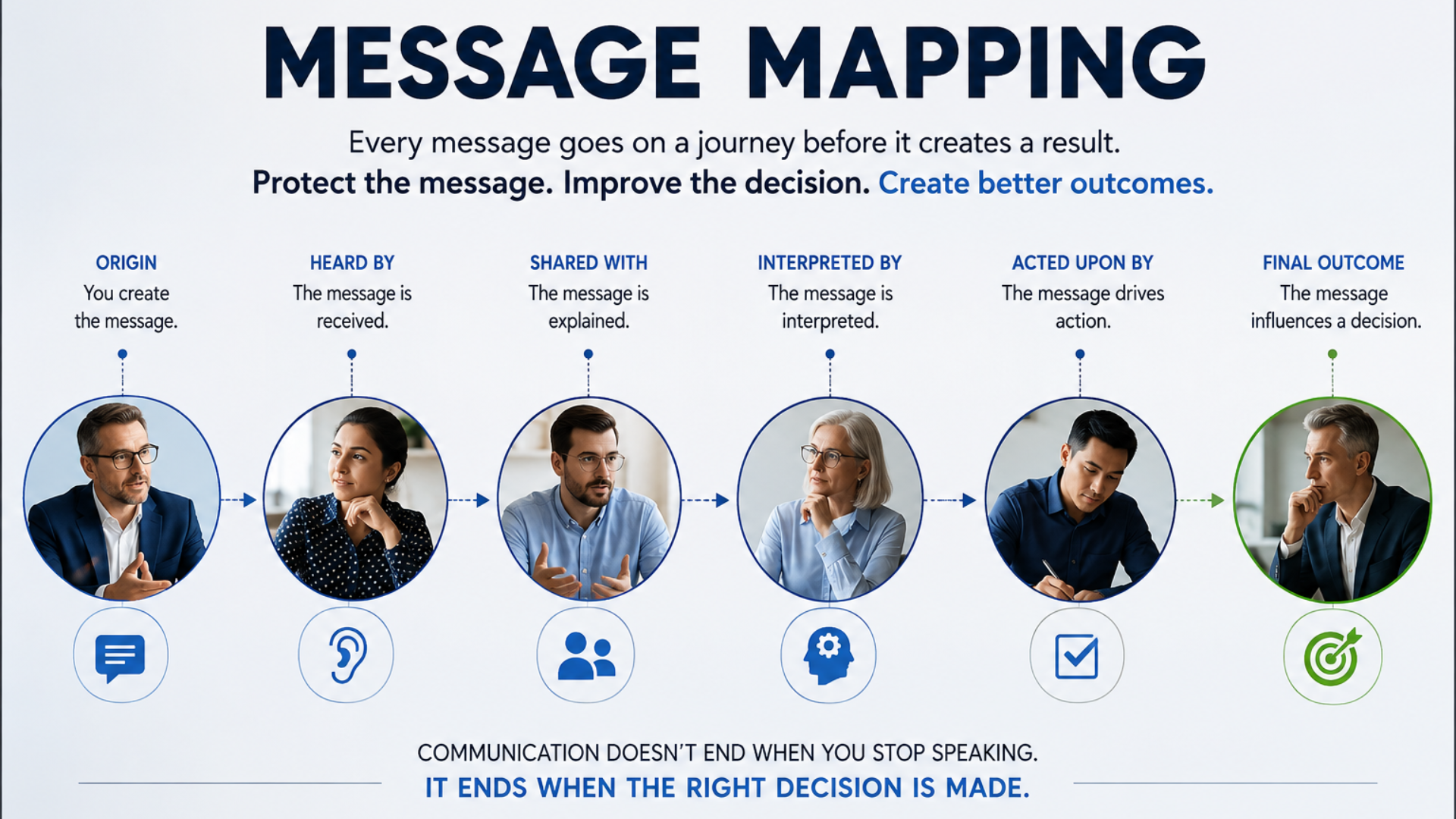
Your Message Left. But Where Did It Go?
You’ve just finished presenting a proposal to your client.
The meeting went well. Everyone nodded, asked sensible questions and thanked you for your time. You leave believing you’ve communicated clearly and that the next decision will be based on exactly what you’ve just explained.
A week later, you discover the proposal has been discussed internally. Information has been repeated, summarised and interpreted by several different people. The final decision is based on something you barely recognise as your original message.
Sound familiar?
This is one of the biggest reasons why communication fails in business. The problem isn’t always what was said. More often, it’s what happened after the message left the person who created it.
Most of us think communication ends when we finish speaking.
It doesn’t.
That’s where it begins.
Key Takeaways
- Communication continues long after you stop speaking.
- Messages often fail during their journey.
- Better decisions begin with better understanding.
- Message Mapping™ reveals hidden communication failures.
- CEDAR™ helps protect meaning from sender to outcome.
Why Communication Fails
Ask someone why communication fails and they’ll usually point to poor listening, unclear emails or badly delivered presentations.
Those things certainly contribute.
But they only explain part of the story.
Most communication advice focuses on helping people become better senders. We are taught how to write more clearly, present with confidence and structure our thoughts logically. Those are valuable skills, but they only deal with the first few seconds of a much longer process.
Communication doesn’t exist in isolation.
It moves.
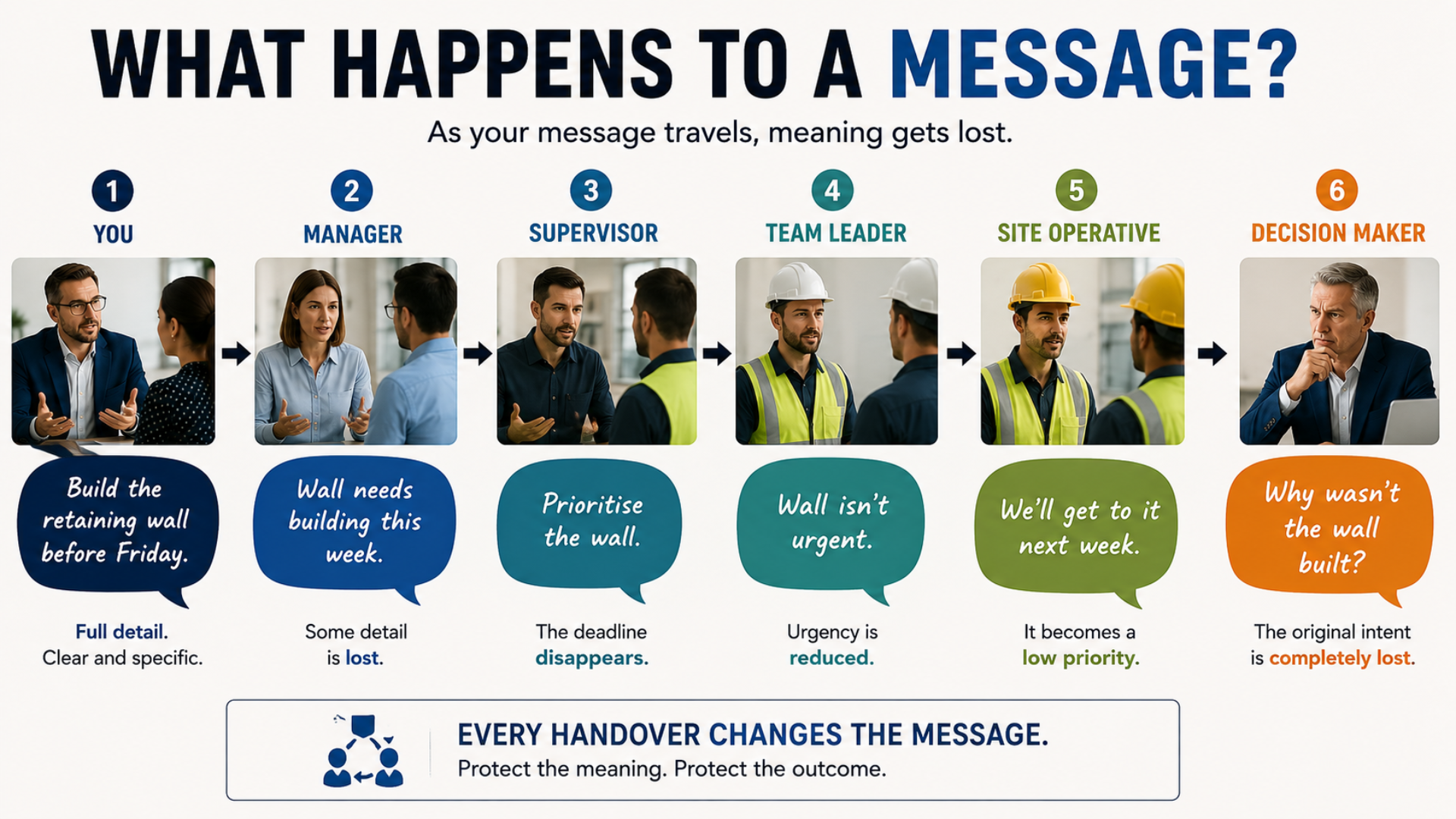
A manager briefs a supervisor.
The supervisor explains the task to a team leader.
The team leader passes instructions to site operatives.
The operatives speak to subcontractors.
The subcontractors update the client.
Every conversation changes the message, even if only slightly.
Why Good Messages Break Down
Imagine filling a bucket with clean water.
Now pour a little into another bucket.
Then pour a little into another.
Keep repeating the process.
Eventually, the water still reaches the final bucket, but every transfer increases the chance of contamination, loss or change.
Messages behave in much the same way.
Every person who receives information interprets it through their own experience, priorities and assumptions. They decide which details matter most and unconsciously edit the message before passing it on.
That isn’t deliberate.
It’s simply human.
This explains why two people can attend exactly the same meeting yet leave with completely different understandings of what was agreed.
It also explains why projects drift, why customers become frustrated and why leaders are often surprised when teams fail to execute exactly what was intended.
Communication isn’t breaking because people don’t care.
It’s breaking because nobody is paying attention to what happens after the message has been delivered.
Introducing Message Mapping
That observation led me to develop Message Mapping™.
Most communication models teach you how to communicate more effectively.
Message Mapping™ teaches you what happens after you’ve communicated.
Instead of asking:
“Did I explain this clearly?”
it asks a different question.
“What happened to my message after it left me?”
That shift changes everything.
Because every important message goes on a journey.
It moves through conversations.
Departments.
Organisations.
Clients.
Teams.
Decision-makers.
At every stage it either keeps its meaning or loses some of it.
The better you understand that journey, the more influence you have over the final outcome.
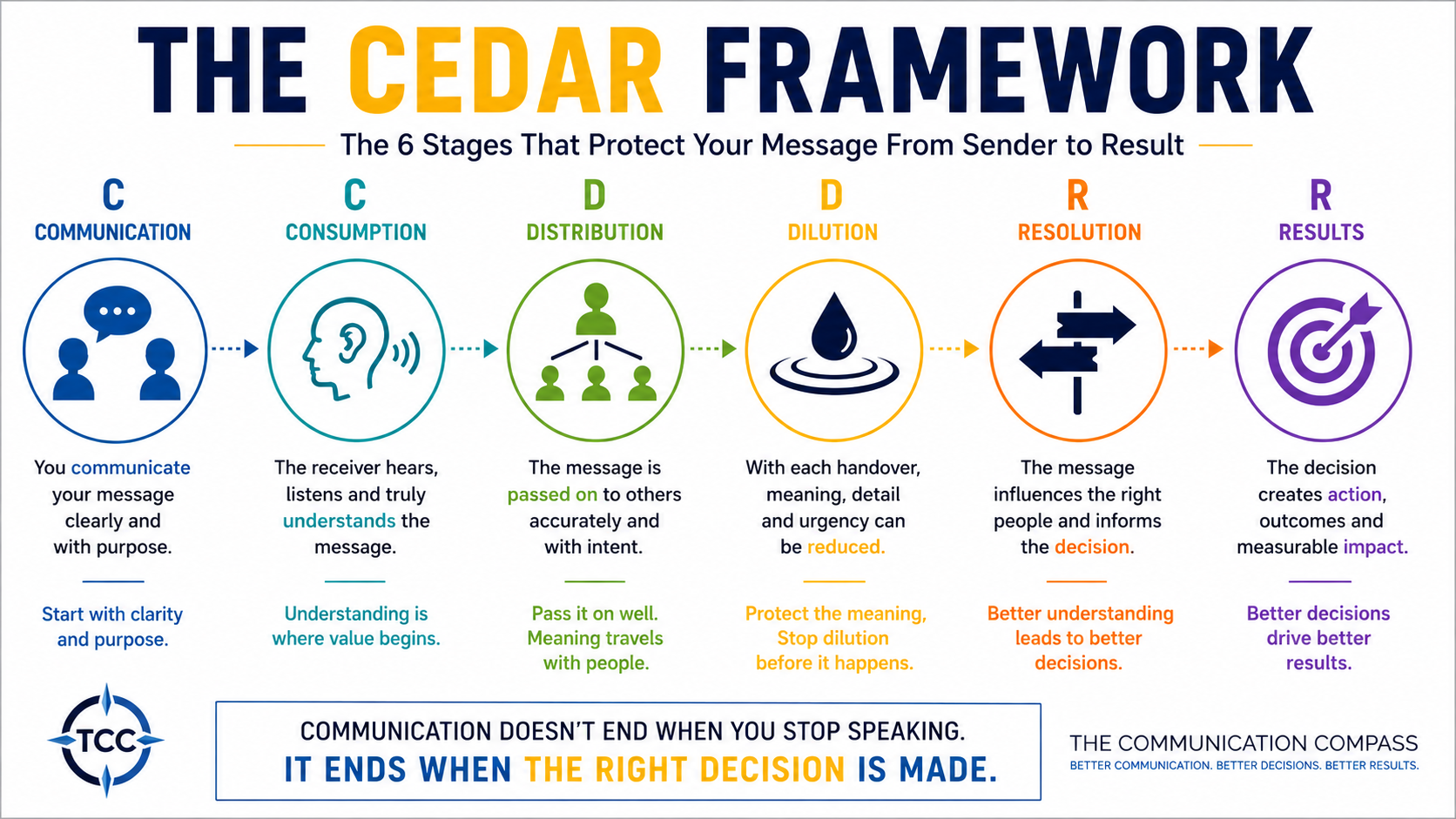
To make that journey visible, I developed a simple six-stage framework called CEDAR™.
It follows every important message from the moment it is communicated until it produces a result.
The CEDAR Framework
Think of CEDAR as six checkpoints.
Your message passes through every one of them before it creates an outcome.
Strengthen each checkpoint and your message arrives intact.
Ignore them and communication slowly begins to unravel.
C — Communication
Everything starts with communication.
This is where most people focus all their attention. The words, the structure, the confidence and the delivery all matter.
However, clear communication isn’t simply about saying something well.
It’s about saying it in a way the other person can genuinely receive.
A Driver usually wants speed, outcomes and brevity.
An Analyst wants logic, evidence and detail.
A Connector wants to understand the people involved.
An Explorer wants possibilities and future opportunities.
The message may stay exactly the same.
The delivery should not.
Communication becomes significantly stronger when you adapt it to the person receiving it rather than expecting everyone to receive information in the same way.
C — Consumption
Sending a message doesn’t guarantee understanding.
People consume communication at different levels.
Some simply hear it.
Others listen carefully.
Only a few genuinely understand both the content and the intention behind it.
That difference matters far more than most people realise.
Many leaders leave meetings believing they have communicated successfully because nobody asked questions.
Silence is often mistaken for understanding.
In reality, people may simply have heard the words without fully appreciating what they mean or what action they require.
Understanding is the point where communication starts creating value not before.
D — Distribution
Very few important messages stop with the first person who hears them.
They move through organisations, teams and clients. A manager briefs a supervisor. A supervisor updates a team. A consultant explains something to a client, who then repeats it to colleagues. Before long, your message is travelling without you.
This is where many communication problems begin.
The person who truly understood your message is likely to pass it on accurately. They’ll preserve not only the information, but also the intention behind it. Someone who only partly understood it will unknowingly edit it. They simplify it, shorten it or leave out details they didn’t realise were important.
That’s why one simple question is so valuable:
Could the person I told explain this to someone else and have it still sound like the message I originally intended?
If the answer is no, the communication process has already started to break down.
D — Dilution
Distribution naturally leads to dilution.
Think back to the childhood game where one person whispers a message to the next until it reaches the end of the line. The final message usually bears little resemblance to the first.
Business communication is often no different.
As information moves through people, it loses detail, confidence and context. The facts may survive, but the meaning slowly fades.
A project brief becomes a summary.
A priority becomes a suggestion.
An urgent issue becomes something that can wait until next week.
The message still exists, but it no longer carries the same weight.
This is one of the biggest reasons why communication fails inside organisations. Everyone believes they are passing on the same information, yet every conversation removes another small piece of the original meaning.
The solution isn’t to send longer emails or hold more meetings.
It’s to create communication that is so clear and memorable that the meaning survives the journey.
R — Resolution
Every important message is trying to influence a decision.
Whether you’re asking a client to approve a proposal, a team to change direction or a supplier to meet a deadline, communication exists to create action.
That’s why the quality of the decision depends entirely on the quality of the message that reaches the decision-maker.
People don’t decide based on what you said.
They decide based on what they understood.
If your message has been diluted, the decision is made using incomplete information.
If it has been misunderstood, the decision may be completely wrong.
But when the message survives every stage of the journey, decisions become faster, more confident and more accurate.
Good communication doesn’t guarantee good decisions.
Good understanding does.
R — Results
Every conversation eventually produces a result.
Sometimes that result appears immediately. Sometimes it takes weeks or months to become visible.
Projects succeed or fail.
Customers stay or leave.
Teams become engaged or disengaged.
Businesses earn referrals—or they don’t.
What people remember isn’t usually the meeting, the email or the presentation.
They remember the outcome.
That’s why the final stage of Message Mapping matters so much.
Better communication leads to better understanding.
Better understanding improves distribution.
Good distribution reduces dilution.
Reduced dilution produces better decisions.
Better decisions create better results.
And better results build trust.
Trust strengthens relationships.
Strong relationships create loyalty.
And loyalty leads naturally to referrals.
As I’ve said many times:
Relationships create referrals. Moments simply trigger them.
Why Message Mapping Changes Everything
Most communication models concentrate on helping people communicate more effectively.
Message Mapping takes a different approach.
It asks you to think beyond the moment you finish speaking and consider everything that happens afterwards.
Where is the message going next?
Who will repeat it?
Where is it most likely to lose meaning?
Which decision will ultimately be influenced by it?
Those questions encourage a completely different way of thinking.
Instead of measuring communication by how well you delivered it, you begin measuring it by how accurately it arrives.
That shift changes the way leaders lead, managers manage and teams communicate.
You stop hoping your message lands.
You start designing it to survive the journey.
FAQs:
Q: What is Message Mapping?
A: Most of it comes down to misreading people, not missing facts. Two people read the same situation in different ways. The message gets sent, but it doesn’t land. The result turns up later as rework, delay or a dispute.
Q: Why do messages get misunderstood?
A: Messages are misunderstood because they are interpreted through personal experience, assumptions and communication preferences. As they are repeated, they often lose detail, meaning and intent.
Q: What does CEDAR stand for?
A: CEDAR is the six-stage framework used within Message Mapping:
- Communication
- Consumption
- Distribution
- Dilution
- Resolution
- Results
Together, these stages show where messages either retain their meaning or begin to break down.
Final Thoughts:
Most people think communication ends when they stop talking.
It doesn’t.
That’s simply the point where the journey begins.
Every message travels through people, conversations and decisions before it finally produces an outcome. Understanding that journey changes the way you think about communication forever.
You stop asking:
“Did I communicate clearly?”
Instead, you ask:
“What happened to my message after it left me?”
That single question has the power to improve every conversation, every decision and every relationship.
Because communication doesn’t end when you finish speaking.
It ends when the right message reaches the right person, in the right way, at the right time—and leads to the right decision.
Speak soon.
P.S. If you’d like to find out how improving confidence, communication and decision making can benefit your business. Solve that problem here.

- Why Site Teams Don’t Speak Up (And How to Fix It) - August 26, 2026
- Reducing Site Errors Through Better Briefings: A Practical Guide - August 14, 2026
- Communication Intelligence in Construction: A Proven Way to Cut Rework Costs - August 7, 2026